
Height is the one thing that can ruin a grow on its own. You can correct a feeding mistake and you can wait out a slow start, but a plant that has grown into the lamp cannot be made smaller again. It is also the figure seed listings get right most often, so it is worth reading before anything else when the space is fixed.
The three classes
Shops sort height into rough bands. In this index that comes to 301 compact strains, 490 medium and 141 tall. Those bands do track flowering time, though less dramatically than their reputation suggests: the median flowering stage is 55 days for compact strains and 56 days for tall ones.
Both figures come from the listings themselves, so they carry the same warning as everything else on them: they describe the plant the breeder grew.
The stretch is the part people forget
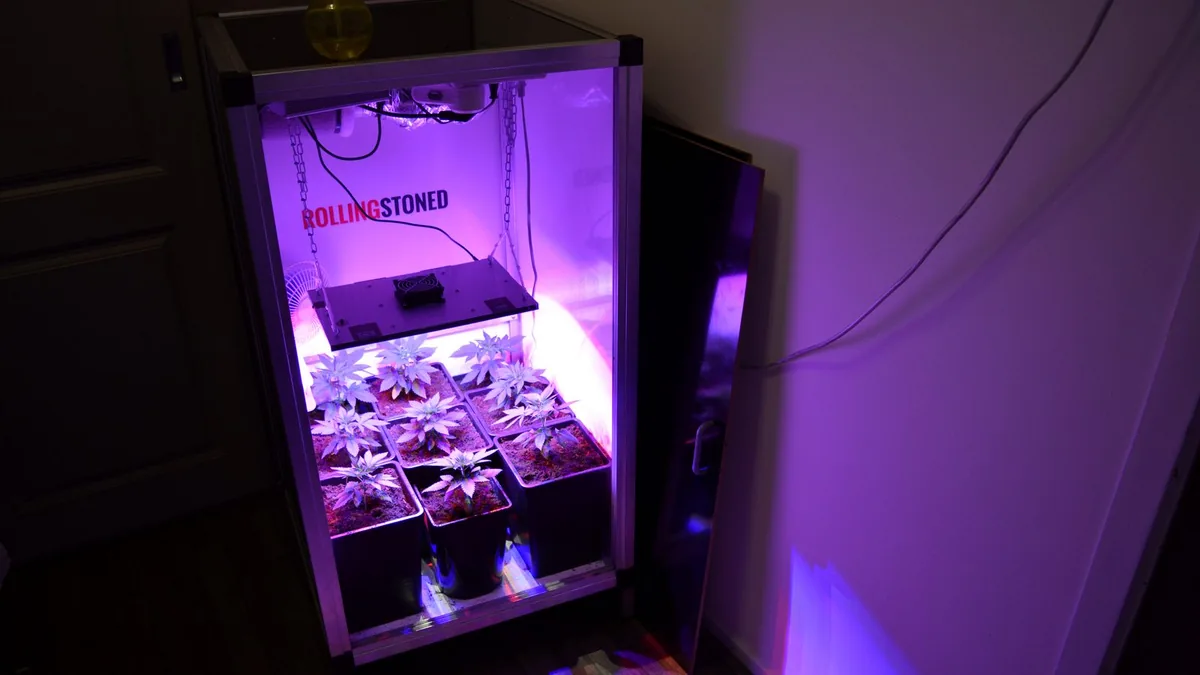
Photoperiod plants do not stop growing when flowering starts. They keep going for the first two to three weeks, usually adding half their height again and sometimes doubling it. So the number to plan around is not the height at the moment you switch the light, but that height plus the stretch, plus the gap the lamp needs above it.
Worked through for a typical tent: about 180cm of usable height, less 30cm for the lamp and the distance it needs, less 20cm for the pots, leaves roughly 130cm for the plant. Switch a photoperiod at 60cm and a doubling puts you against the ceiling exactly.
Autoflowers decide for themselves when to flower, which is why they suit short spaces: by the time you notice how tall one is, it is as tall as it is going to get.
Keeping a plant inside the space
Three approaches, from the gentlest to the most drastic.
Switch the light earlier. The simplest option, and always available on a photoperiod plant: less time growing leaves means a smaller frame going into flower.
Bend rather than cut. Tying branches outwards flattens the canopy and spreads it across the lit area, and it costs the plant no recovery time at all. A screen does the same job more methodically.
Top or prune. Cutting the growing tip gives you two leaders instead of one and a shorter, bushier plant, at the cost of several days of recovery. Do it to an autoflower and those days are gone for good: it flowers on schedule either way.
Outdoors, height is a different problem
Outdoors the ceiling is not physical but social, and it makes tall varieties conspicuous in a way compact ones are not. Wind and support also matter more: a two-metre plant heavy with wet flower needs staking that a compact one never does. The outdoor guide covers the season around that.
Choosing on this site
Every strain page states the height class next to the flowering window, and the compact, medium and tall lists are filtered on that field. For a small tent, compact plus a short flowering time is the combination that keeps both constraints satisfied at once.