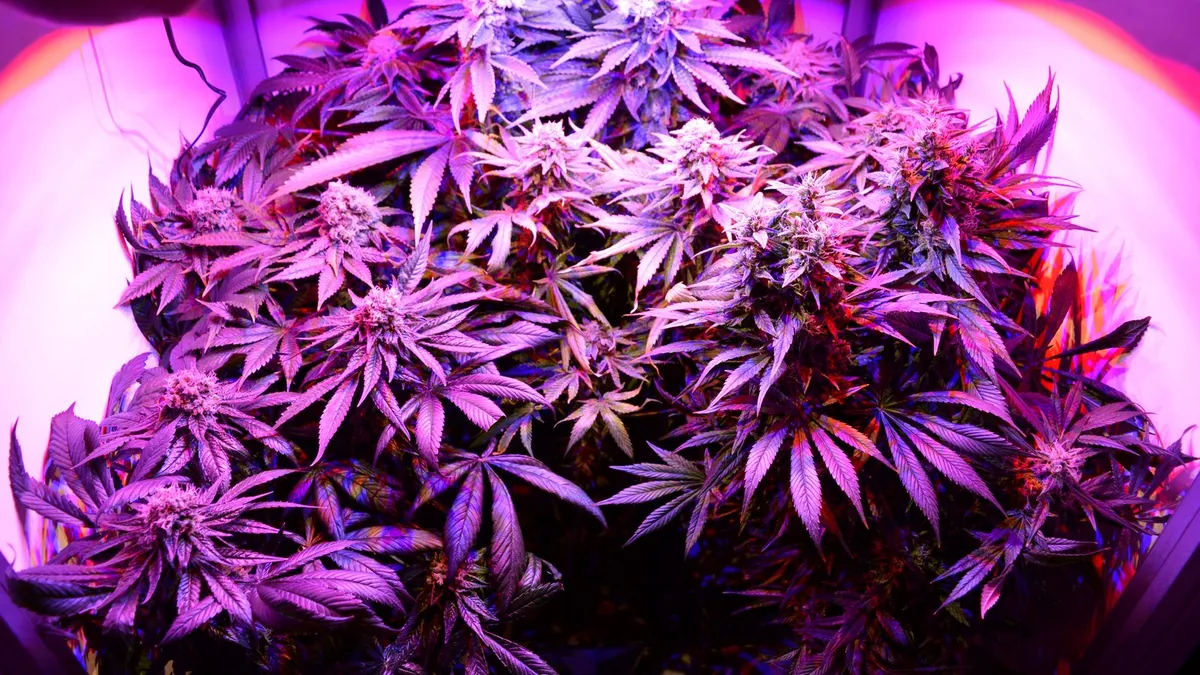

Indoors, nothing arrives by itself: light, air, water and nutrients all have to be supplied. That is what makes a room controllable, and it is also what makes it work. What follows is ordered by how much each one decides the outcome, because equipment guides tend to give a carbon filter the same weight as the lamp, and the two are nowhere near equal.
Light
Light sets the ceiling for everything else, and it is the thing most often bought on the wrong number: wattage tells you what a lamp draws from the wall, not what reaches the plant.
The measure that matters is PPFD: the light landing on a surface, counted in micromoles per square metre per second. Seedlings need little, somewhere around 100 to 300. Vegetative growth sits comfortably at 400 to 600. Flowering is where intensity pays off, usually 600 to 900, and going higher only helps if you raise CO₂ to match, which is a commercial concern rather than a cupboard one.
Two things follow from that. A lamp is matched to an area rather than to a number of plants, because spreading the same light over twice the floor halves the intensity. And the hanging height is not a detail. Distance changes intensity sharply, which is why manufacturers give a range for each stage, and why bleached, pale tops on the tallest plant usually mean the lamp hangs too close rather than that it is too strong.
Air
Air does three jobs: it removes heat, it replaces the CO₂ the plants use, and it moves the leaves. An extraction fan handles the first two. A small oscillating fan handles the third, and it earns its place: still air lets humidity sit against the leaves, which is where mould starts, and stems that are never moved stay weak.
Smell is a separate problem with a separate answer: a carbon filter on the extraction. It does nothing for the plants themselves.
Water and medium
Choosing a medium is mostly choosing how often you want to be involved.
Soil holds nutrients and buffers mistakes. Pre-fertilised mixes carry a plant through the first three to four weeks unfed, and pH sits comfortably between 6.0 and 7.0. Water when the top two to three centimetres have dried out, and lift the pot if you are unsure: the weight tells you more than the surface does.
Coco coir holds no nutrients at all, so you feed everything, every time, and the pH target is lower at 5.5 to 6.5. It also needs the calcium and magnesium that soil normally supplies. In return it drains fast, is hard to overwater, and grows plants noticeably quicker.
Overwatering is the commonest mistake in either medium, and it does not look like too much water. It looks like a plant drooping and not recovering, because roots sitting in saturated medium cannot take up oxygen.
Feeding
Cannabis uses nitrogen heavily while it is building structure, and shifts toward phosphorus and potassium once it flowers. Any two- or three-part nutrient line covers that, and the manufacturer's schedule is a starting point rather than a prescription. Starting at half to three-quarters strength costs you a little growth and saves you the burnt leaf tips that come from the alternative.
Whatever the concentration, pH decides whether the plant can absorb it. Outside the range for your medium, nutrients are present and unavailable, and the symptoms look exactly like a deficiency, which is why people so often respond by feeding more.
The stages, and how long they take
| Stage | Typical length | What decides the end of it |
|---|---|---|
| Germination | 1 to 5 days | taproot, then a seedling |
| Seedling | 1 to 2 weeks | first true leaves, higher humidity helps |
| Vegetative | 3 to 8 weeks | your choice, or age for autoflowers |
| Flowering | 7 to 12 weeks | the strain, stated per listing |
| Drying | 7 to 10 days | 18 to 22°C, 55 to 60% humidity |
| Curing | 2 weeks upward | sealed jars, aired regularly |
Photoperiod plants stretch when the light goes to 12 hours, often adding half again to their height in the first weeks of flowering, so the space to plan for is not the size at flip. Autoflowers do this on their own schedule, which is one of the reasons they are grown in tight spaces.
Flowering times in this index run from a median of 56 days for indica-labelled strains to 56 for sativa-labelled ones. Every listing states its own, so the planning can be done before the seed is bought rather than after.
What actually goes wrong
Ranked by how often they happen: too much water, pH drift, too much feed, a lamp hung too close, and cutting early. The first four are covered in when things go wrong; the last belongs to harvest, drying and curing, which is where a good grow is most often spoiled.