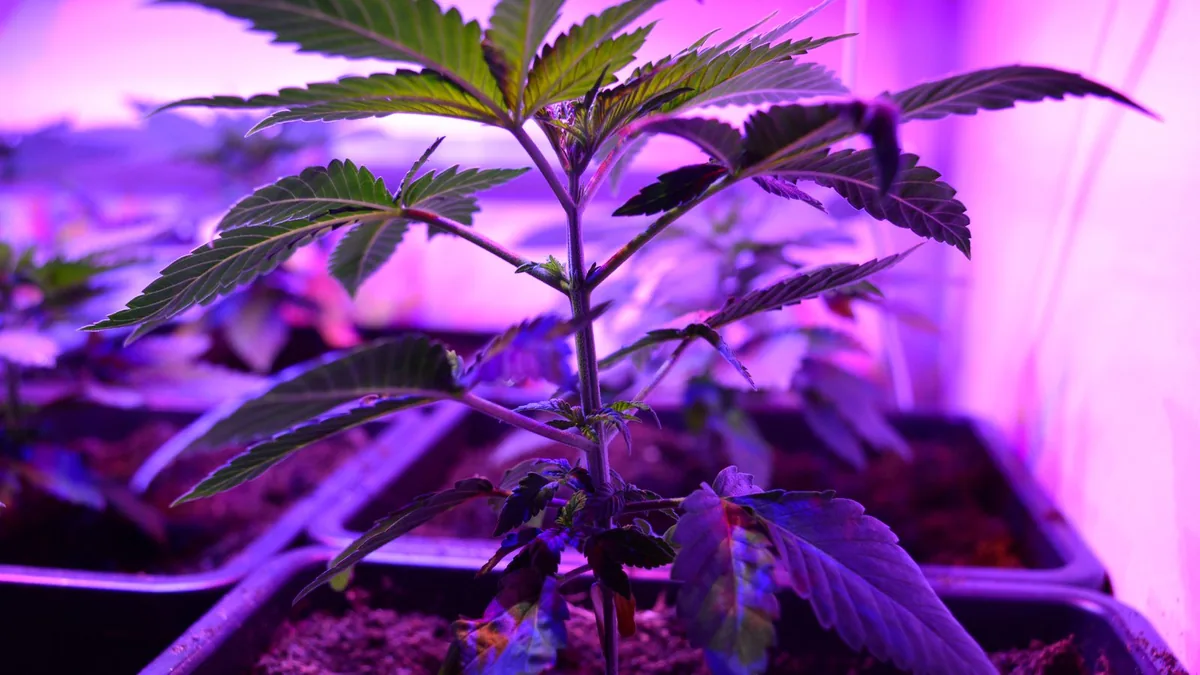

A plant grows to the size its roots can support. Everything above ground, the height, the canopy, the weight of the flowers, is limited by what is happening in a container most growers pick without much thought.
Size sets the ceiling
Roots fill a pot and then stop. Once they have, the plant slows, dries out faster between waterings and stays smaller than the light and the space would have allowed. Working backwards from what you want above ground is the sensible way round.
As a rough guide: three to five litres carries a small autoflower to harvest, eleven litres suits most indoor photoperiod plants, and fifteen to twenty-five litres is for plants that get a long vegetative stage or grow outdoors. Bigger is not automatically better. A seedling in a twenty-litre pot sits in wet medium it cannot use, which is the fastest route to the root problems described in when things go wrong.
Fabric or plastic
Plastic holds water longer, costs less and lasts for years. Fabric dries faster, breathes, and does something plastic cannot: when a root reaches the wall it meets air and stops, and the plant branches out behind it instead of circling the pot. That is air pruning, and it produces a denser root mass in the same volume.
Growers who have measured it report noticeably more root mass and better yields in fabric at the same size, and suppliers quote figures in the region of twenty percent, which is a number worth treating as a direction rather than a promise. Fabric also runs cooler in warm rooms, where a black plastic pot in the sun can push the root zone well above the point at which roots stop taking up nutrients.
The trade is water. Fabric needs watering more often, and in a dry room noticeably more often.
Potting up, or not
Starting small and moving up gives you a plant whose roots always have somewhere to go and medium that is never sodden. It costs a few days of recovery at each move and one chance to damage the roots.
Going straight into the final pot avoids all of that and demands more care with watering in the first weeks: water a small circle around the seedling rather than the whole surface, so the medium it is not yet using stays dry.
Autoflowers are the exception with no argument attached. They flower on age, so days lost to transplant shock are days they never recover; put them in their final container from the start, as the germination guide says.
What it means for the space you have
Pot volume takes height as well as floor. A twenty-litre pot stands roughly 35cm tall before the plant starts, which comes straight off the distance between the medium and the lamp. In a tent that is measured in centimetres, the pot is part of the arithmetic in height and space, not an afterthought.
Floor area is the other half. Pots that touch each other leave no room for air to move between them, and still air in a dense canopy is where mould begins.