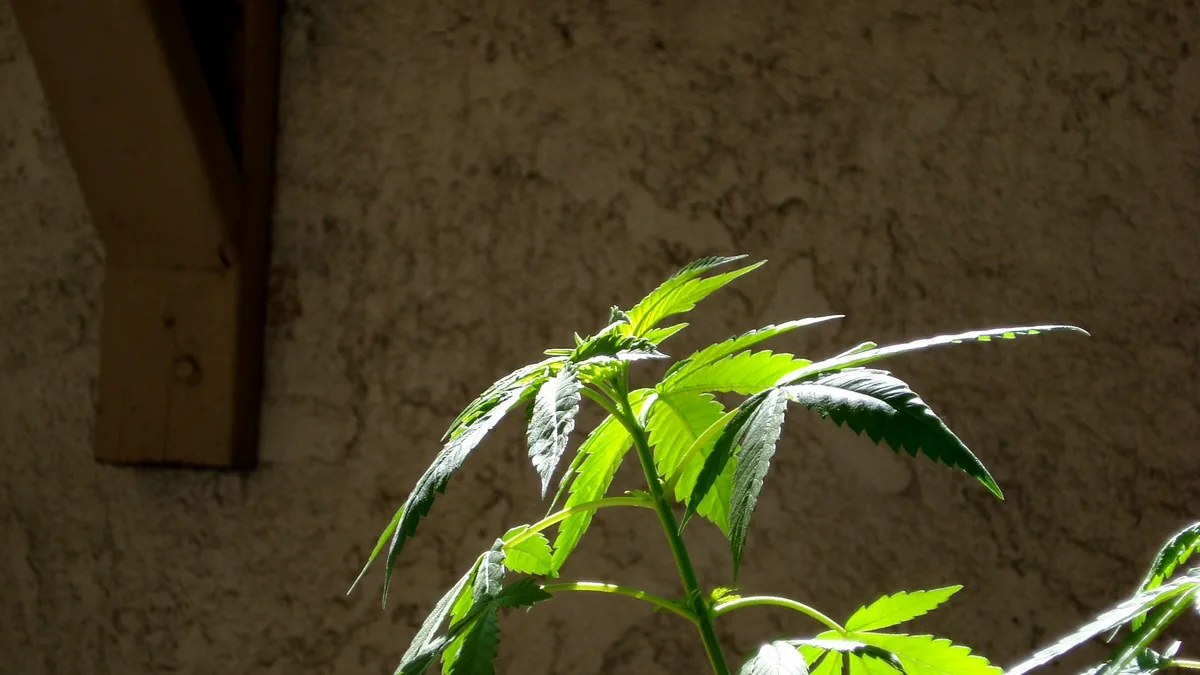

Left alone, a cannabis plant grows one dominant top with smaller branches beneath it. Under the sun that works well enough. Under a lamp it wastes most of the light, because that single top sits in the bright centre and everything else stands in its shadow. Training is the set of techniques for flattening the plant so that the lit area fills evenly.
The problem it solves
A lamp lights an area, not a plant. Whatever grows inside that area gets light; whatever grows beneath the canopy or outside it does not. Training does not make a plant bigger; it rearranges the plant into the space that is already lit, which is why these techniques matter far more in a tent than in a field.
Low-stress training
Bend the branches outwards and tie them down so the plant grows wide instead of tall. Nothing is cut, so there is no recovery time and no risk of infection, and you can start as soon as the stems have enough give in them.
This is the technique that suits autoflowers, exactly because they cannot afford to recover from anything: they flower on age, and days lost to stress never come back.
Topping and fimming
Cutting the growing tip breaks the plant's apical dominance and turns one main stem into two, or into several if you only cut part of it. The result is a shorter, bushier plant with more even tops.
The cost is real: several days of slowed growth while the plant reorganises. On a photoperiod plant, which stays in vegetative growth until you decide otherwise, that time is free. On an autoflower it is not.
Timing matters more than technique. Topping is done in vegetative growth, and never once flowering has started.
Screens
A screen of horizontal netting above the pots turns training into a routine: branches are tucked under the mesh as they grow, and the canopy fills the screen square by square. It is the most systematic answer to the same problem and the least forgiving of neglect, since a week of not tucking undoes the shape.
Defoliation, carefully
Removing leaves to expose bud sites is the most argued-over practice in growing. Leaves are where the plant makes its energy, and stripping them costs it capacity. Remove what is genuinely shading a flower site, and leave the rest. Removing large amounts during flowering is a stress with no reliable payoff.
Stretch decides the plan
Photoperiod plants extend for the first two to three weeks of flowering, often by half again. Training is therefore something you finish before the switch, not something you start after it: the shape you flip is the shape you get, stretched. Height and space has the arithmetic.
When not to train at all
A short grow in a large space needs none of this. Neither does an autoflower in a tent with room to spare. Training solves a specific problem, uneven light over an uneven canopy, and applying it where that problem does not exist is a way to lose plant time for nothing.